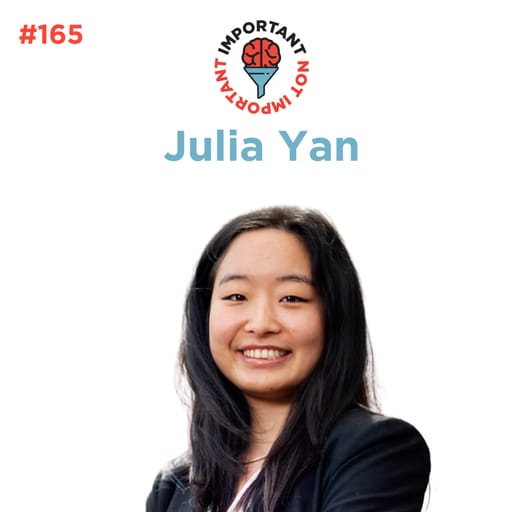
Transcript 0:00 Hey, folks. It's Quinn. Since we recorded this conversation, we've renamed the podcast. It used to be called Important Not Important, which is what you'll hear in the episode and is still the name of the company. 0:12 But now the podcast is called The Most Important Question, that is, what can I do? 0:18 It's the question we get the most from all of you, and it turns out it's the question I've really been asking guests for almost two hundred episodes now. So here we are, The Most Important Question. 0:29 Please enjoy this old conversation. Thanks for listening, and thanks for giving a shit. [upbeat music] What are microplastics doing to us, and how do we stop putting them into our water and our bloodstreams and our food? 0:47 That's today's big question, and my guest is Julia Yen. Julia is the co-founder and CEO at Balena, a closed loop, consumer-facing laundry startup working to tackle ocean microplastic pollution. Yeah, it's a big deal. 1:04 Julia is a recent graduate at UPenn, and with her two co-founders, some funding, including from our friends at Seven Seven Six, and a bunch of big name partners, they're trying to tackle one of the microplastic inputs: your washing machine. 1:19 Microplastics are not great, but they never make it onto the top ten list of concerns people have before an election or ever. You know, uh, economy, healthcare, guns, crime, war, heat, all those things. 1:36 But they should, because they are so prevalent that we have found them on the bottom of the ocean and on the top of mountains. We have found them in deserts, in our crops, in our soil. 1:47 We have found them in adult bloodstreams and in unborn babies and placentas. 1:53 And that's all in an age where over the past sixty, seventy years, uh, we're eating more and more ultra-processed food, and we are eating it out of and drinking it out of plastic. And we are wearing plastic. 2:08 And we're all looking around at our decaying health and comorbidities and, uh, shorter life expectancies and going, "What the hell is going on here?" 2:19 So it is an enormous, wildly complicated problem, where I'm not making as many assumptions as I usually would here because it is so complicated, but the implications are becoming more clear. 2:32 The good news, like carbon emissions, we can choose to stop it. It's just going to take an intentional, systemic approach and people like Julia. Welcome to Important Not Important. 2:44 My name is Quinn Emmett, and this is science for people who give a shit. 2:48 In these weekly-ish conversations, I take a deep dive with an incredible human, like Julia, who's working on the front lines of the future to build a radically better today and tomorrow for everyone. 3:00 And along the way, we'll discover tips, strategies, and stories you can use to understand and unfuck our rapidly changing world. Let's go. [pensive music] Julia Yen, welcome to the show. Thanks for having me. 3:16 [chuckles] You're very welcome. I'm just realizing this room, which looks fancy, it is not. It is about a four-by-four, like, uh, g- you could call it, like, a kidnapping room, basically. 3:27 [laughs] Like, with all the different things and, like, the Amazon sound stuff on the walls. I'm realizing I wore a shirt that's the exact same color as my painted wall. 3:35 So I don't know if the, the youths will green screen me or not. But anyways. [laughs] This is so great. It is so lovely to have you on the show. 3:42 Lizzie Garvin over at Seven Seven Six has been so great to share basically... Well, y- y- you all are among the second iteration, right? The second class of fellows, I believe they call you. 3:53 And it is so inspiring, humbling, terrifying, all of the things to-- Basically, she sends me sort of this two-page list of, "Hey, here's the new, the new folks. Let me know if you wanna talk to anybody." 4:05 And you read them, and you're just like, "What? Who the... How the hell does someone even start figuring something like this out?" 4:11 So it's amazing, and we were so excited to read about what you're working on, which is really important right now, but it [chuckles] feels like one of those things that the more we find out, it's gonna feel really, really important. 4:23 It is one of those things I think about when I... You know how they do the polling of everybody every year and go, "What are the top ten things you care about in this election?" 4:30 And, like, m- microplastics is not on the list, but it should probably be in the top three if we actually really thought about it, but there's al- so much other shit going [chuckles] on every day. 4:38 So anyways, it is a delight. I'm so excited for you to blow me out of the water with all of these things, literally. Julia, I start with one important, ridiculous question. 4:49 You said you cheated and listened to a few episodes, so you know, I guess that goes out the window. But, um, I like to ask, why are you vital to the survival of the species? 4:59 And the longer I do it, it really sounds ridiculous, but I would love to hear your feedback. [laughs] Yeah, I did my research going in. 5:07 Um, but I think it's a really interesting question, and I did a little bit of thinking. I kinda slept on this so I'd have at least something to say. Um, I guess the first thing, I think, like, what 5:18 I would say, like, my response is rooted in is, like, I really believe that individual actions, even if it's just coming from one person, can really lead to collective meaningful change. 5:27 And so yes, I am just one person, um, but I hope that maybe the things that I'm putting into place or, you know, the words I say or the conversations I have can have a ripple effect on a larger amount of people and eventually, you know, the entire species. 5:41 So I guess, uh, the first part of my response is I'm super passionate, and I spend a lot of time and the free time that I can trying to empower other young women that maybe wanna pursue entrepreneurship or wanna do something a bit unconventional. 5:54 I would say I had a pretty unconventional journey to get to where I am today, um, you know, coming out of college, doing entrepreneurship. 6:00 And so I do want to try to motivate and persuade other young women to, to take that chance if it's something they really believe in and, and to wanna pursue that path. 6:09 And so that's one thing, and maybe, like, the people that I influence through that avenue can then go and change the world in other ways beyond what I'm doing, and that leads to overall change. 6:18 And I guess the second thing is just Balena as a whole, like, what we're doing. I hope it does change the world. 6:23 Um, we're working on microplastics in water, and I think this is an issue that actually affects, like, everyone. It's in all of us. It's in, you know, our blood, our lungs- Literally... water, salt, seafood, beer. 6:34 And so it's, like, something that feels super ubiquitous. 6:37 And so hopefully the, the changes that we can make within that kind of niche avenue do lead to overall, you know, like, change for humankind, but that's pretty optimistic. I love that. I love that ambition. 6:48 It's fantastic. I have so many things I already wanna come back to here. Um, usuallyWe're gonna put a pin in about six of them, uh, including I, I was just thinking about, do you know who Carl Sagan is? Mm-hmm. 6:59 Had a quote at one point, I'm gonna completely mangle it, something about like we're all stardust. Now we're all microplastics. It's great. You're right. It is ubiquitous. It literally is in all of us. 7:08 Um, so it couldn't be more important. I wanna come back to the technicals of that and the why of- Mm-hmm... why you're working on all that. 7:15 But we usually don't spend too much time talking about how you got here, your life journey, this and this, unless it's directly applicable to what you're doing. 7:23 But you did mention you had a bit of an unusual journey to get here, and like we were saying offline, it is really important to me to help listeners understand why you are doing this work and why you're doing this work. 7:35 So could you fill that in a little bit? Tell us a little bit about your journey, because you graduated pretty recently, but- Mm-hmm... what happened before that? How did we get here? Yeah. 7:44 I guess kind of like this whole journey into climate started when I was in high school. This was around, I would say I was 15 or 16 years old, so like 2015, 2016, and it was like peak Flint, Michigan water crisis. 7:55 And I remember just like sitting in front of the TV and feeling super outraged, honestly, that things were going so slowly. Like, I felt as though we'd been stuck in that cycle for, for years and years at this point. 8:07 I was back in high school. I had this strong interest in science. I'd always been kind of a tinkerer, but I didn't know how to apply that. 8:12 I just liked to build things, and so I figured like why not devote some time, some resources to trying to figure this out? 8:19 And so I worked on water filtration, which is kinda like what I do now, but at the time it was for heavy metal filtration, and so how do we get lead out of contaminated water? Uh, I thought it was really fun. 8:29 I thought it was really interesting. I was super, I think, motivated to do so. It didn't really feel like work, but to me, I went to college, and I was like, okay, now it's time to find what I'm gonna do for work. 8:39 And so I studied chemical engineering for a semester to realize it wasn't what I wanted to do. I went to material science engineering, which is, I would say adjacent, but more focused on, like, matter. 8:49 And I was more interested in like nanoscale materials and nanotechnology. I just thought that stuff was really cool. I loved quantum. And so I did a little minor pivot in college. 8:59 Maybe it's because I am like an older sibling, I'm an older sister, the, the kids of like two immigrant parents, uh, or maybe 'cause I went to Penn, which is a very professional school, quite competitive. 9:11 I feel like I was really pushed towards roles like investment banking and consulting and, and things that at the end of the day I think aren't super aligned with my personal vision, but I felt that pressure, and so I, I went that path. 9:22 [laughs] I went to consulting, and I did a, a whole summer internship, kinda like one of my most pivotal internships my junior year. 9:30 And maybe I was just on a like specific project or a certain role that gave me a glimpse of consulting that made me very disillusioned, but I felt like this was kinda pointless. Like, to me, 9:42 everyone always jokes like, "What is consulting?" 9:44 I thought it was like we listen to clients, and they tell us like all their thinking and, and what they wanna do, and then we just take it and repackage it and then just like give it back to them in a nicer way to help them say like, "Yeah, you can lay off these people," or, "Yes, this like requires this kind of reorganization," and we give them justification for it so they can go back to their employees and say like, "Okay, we brought in this external group, and they say we need to lay you off." 10:09 I guess for me, I was kinda like, this doesn't feel like what I wanna do, at least not with like my career just starting out. I was just about to graduate college, and I felt like a cog in the wheel. 10:21 And I remember like back in high school how much I enjoyed the work that I was doing. Um- Mm-hmm... it didn't feel like work. Again, it was more like a, a passion project. 10:28 And so I came back to it, and when it came time for like us to create the senior engineering capstone project, we decided, like, let's build something. Let's tackle this issue. 10:38 Um, and I was really driven to pursue water filtration again, and it kind of serendipitously led us to starting our own venture from this like conceptual lab idea. And, and now here we are, a year into it. 10:51 I'm 22 years old, and I don't see myself doing anything else, at least for the near future, [laughs] for the, the next few years. That's all incredible. Thank you for sharing it. 11:00 It is both so unique but also, yeah, it, it feels so predictable in so many ways. I mean, I, I went to Colgate University a thousand years ago. Everything was in black and white. But I, [laughs] 11:13 I feel like, I think I've told this story. And I, I saw this classmate recently again, and we were joking. You know, liberal arts school, really wonderful, pretty small, in the middle of nowhere, very cold. 11:24 You know, we graduated in 2005. So pre-2008, everybody's going into finance in something. I don't even know what half those w- I, I didn't at the time know what half those words mean. 11:33 Whether they were econ majors or not, that's where they went. That's where the job offers were. That's where the alumni were. That's where the money was. Wanna start making it, move to New York or Chicago. Sure. 11:44 I was a, like, atheist religious studies majors who, who focused on, like, religious warfare, and I remember my friend majored in, like, 11:53 Greek, uh, language basically, and we were both watching the TV, and it was gra- [laughs] graduation week, and there's some CNN thing. It was like, "Top 10 most lucrative college majors." 12:04 And needless to say, Greek and religious studies were not on that list, and we were like, "Oh, no." Like, [laughs] "What have we done?" 12:12 But at the same time, I think now, and I've got three kids, as I alluded to, and, and my 10-year-old is, who thinks he's 25, is constantly asking, like, wants to do this, wants to do that, what am I gonna be? Mm-hmm. 12:23 And I was like, "You're gonna be 50 different things. And as much as I hope you, you know, shepherd Bellina into cleaning up our, our everything, uh, forever, you've already done something else, you know? And it's 12:36 all of those things are so helpful to getting you on the path that you feel like you're intended to be on, um, where you can answer the question that is sort of our business here, which is, how can I help?I wanna go back just a moment. 12:50 So you said both your parents are immigrants. Where do they come from? Oh, yeah, they immigrated from China, and they're both scientists as well, so I guess that's kind of like how I got my start- Okay... 12:58 and this natural gravitation maybe to- Sure... to wanna be in this field. So even though they were scientists, they were pushing you a little bit towards the go and make money side? 13:07 I don't think they explicitly did that, but maybe I felt this like burden- Sure... that comes from, like, knowing what they sacrificed to be here and their journey. Like, I, I should want more stability for myself. 13:16 And- Sure... I don't know. Like, even though that is the case, and I still do think that it's something important, I just realize, like, time is almost more valuable to me now and, like, time... 13:26 There's this urgent need, and it's kind of like why work on anything else with the limited time that I have at this moment in time when, like, climate is such a huge issue and something that, like, we were born into, um, like Gen Z as a generation, and kind of feels like we're the last ones who will solve it, at least to create really meaningful change. 13:43 So that's sort of how I feel now about the whole, like, stability and financial stability versus, like, being really passionate about what you work on. 13:50 Like, I, I am leaning towards let me do something that I actually love to do and feel that I need to do, um, at this moment in time. I totally get it. What are their specialties? Yeah. 14:01 So my dad is in chemistry, analytical chemistry, and my mom's, like, in biology, but it borders on, like, paleontology, so- Oh, cool... loved dinosaurs growing up. She'd go on these, like- Yeah... 14:11 fossil digs and come back from Montana, and it was like the coolest thing ever. Ugh, that's awesome. 14:16 I did a, a conversation a few months back, I don't know, time means nothing anymore, with Riley Black, who wrote a really wonderful book about basically she took as much as humanly possible, uh, the information we have right now, which of course changes every month, and then doesn't change for years, about what happened in the seconds, the minutes, the days, the weeks, the months, the years after the asteroid hit. 14:39 And it's- Mm-hmm. The, the prose is so beautiful, and the conversation is so wonderful. And same thing, I'm just like, "Oh, man, how, how cool would it be to just work on dinosaurs?" Like how great is that? 14:49 Um, that's awesome. That's really, really cool. All right. So you had some scientific influence there. You weren't, uh, j- it didn't just come out of nowhere. [laughs] Yeah, I guess, I guess not. 14:58 I think definitely growing up, like, being immersed in labs and, like, when I didn't have school and, like, it wasn't in daycare, I would just, like, be in their offices and, and hear all the conversations. 15:08 No idea what was happening, but I think that definitely, maybe unconsciously, has led to, to where I am now. What about your siblings? Are they running in the other direction or? Uh, so I have a younger sister. 15:18 She is just about to go to college in, like, a couple weeks actually. Mm-hmm. Um, and so she's going the computer science path, something that I wish I had more ta- talent in. But, um- Yeah... super proud of her. 15:29 She, like, makes video games in her free time. So in her free time? Sure. [laughs] Why not? Why not? Um, that's super cool. 15:36 Well, this paints a, a much fuller picture of sort of the, the where you came from and, and sort of what you, what was endemic to, to how you grew up and how you spent time. 15:47 Your stories of spending your childhood years, uh, you know, bouncing around a lab, it, you know, it's like I'm old enough now and I'm, you know, a general sports fan to hear, uh, you see second generation baseball players or whatever, and they're like, "I just grew up in the locker room. 16:02 Like, my dad and all the players treated me, and I took batting practice, and now I'm really good." And you're like, "Well, sure." Mm-hmm. "I guess that's what you saw," you know? [laughs] What you were a part of. 16:10 [laughs] Obviously, there has to be a certain amount of talent, um, and a certain amount of drive to do it, but it makes sense to know that, like, this was sort of the, the nurturing environment you came up on. 16:20 Um, so let's dig into this. Tell me what you have created, and tell me why. Because we can dig into, we can spend two minutes talking about how widespread the problem is, but I think everybody pretty much gets it. 16:35 Microplastics are in virtually everything, which means they're in all of our water and our food, and it... 16:42 We have found them at the top of mountains, at the bottom of oceans, in deserts, and we've also found them in our bloodstreams, people who've been alive and eating and drinking them and inhaling them for years, but we're also finding them in things like placentas. 16:54 So tell me a little bit about how you got to this is the thing I wanna do, and then sort of your scientific process of the thing you created. Yeah. Sure. 17:03 I guess this gets into, like, our founding story at Belina, and it started when we- First of all, hold on. Pause Yeah. Greatest name of all time, by the way. [laughs] Belina. I love... Blue whale, favorite animal. 17:13 This is such a great name. It's so good. Yeah. I'm glad you got it. 17:15 It came out of, like, actually in college, um, me sitting all my roommates and some friends down at a kitchen table and just throwing ideas around, and that one kinda stuck. 17:23 We, we added the A actually 'cause all female founding team- Sure... and a lot of, like, the Latin and, and Spanish, like, words have that as a conjugation. But that was, like, our inspiration. So great. Continue. 17:34 [laughs] Um, founding story. So we were seniors in college. This was 2021, um, just after the pandemic, and the reason we came together as a team really was because we had spent years of, like, classes. 17:46 Material science at Penn is a very close-knit department, only about 30 people in our class. 17:51 And so every class basically we spent together, and we wanted to create something bio-inspired, and that was, like, what really drew us as a team to become a unit. 17:59 Um, bio-inspired meaning, like, we wanted to be looking towards nature for, for the root of, like, what are we gonna build. 18:06 Like, how are we gonna model, um, what we wanna do off of something that already exists and it, it, like, performs well. I really like that. Yeah. 18:12 And so we, we came together, and at the time, you know, being a material scientist, I think plastics is a huge component of, like, what we learn because manufacturing nowadays is so dependent on synthetic materials, and a lot of material science, at least in our department, is focused on, like, the environmental implications and how can we kind of best address that. 18:32 So it was in the back of our minds pretty much the whole time, and we were kinda compelled to tackle this because we had a year in that moment. 18:40 We had a year, we had a little bit of funding, like $500 [laughs] and we figured, like, what can we do that-Would create something more tangible. We didn't wanna just do research and create a research paper at the end. 18:50 We wanted to create something that was more device centric and usable. And so we, we went to who we thought at the time were like, you know, the, the experts on this. 18:59 We went to the Philly Water Department, we went to the EPA, and we were like, "What are you guys doing to solve this? Like, where, where its current state, and how can we fit in?" 19:07 And essentially the takeaway there was like they, of course, they know it exists, they're aware of it, and they're kind of content with where they are right now. 19:13 And wastewater treatment plants as a whole, they can filter for microplastics, uh, with about, you know, 80, 90% efficiency, but a lot of the smaller microplastics do slip through, and there's been quoted like 40% of microplastic fibers can end up in the water streams anyways. 19:27 And a lot of the sludge that comes out of it just gets applied as fertilizer, so it's not really like a, a catch-all solution anyways. 19:34 But they were like, "This is like, uh, working for us, and we don't have the time, really the resources to divert more towards microplastics. There's just so much happening on the, the water level." 19:43 And so we figured like, why not do something about this that we ourselves could use? At the time, you know, we were college students. We rented or we lived in dorms. 19:51 We wanted an easier solution that people like us, college students, eco-conscious young individuals, would feel compelled to, to purchase and, and create habits around and actually like start, you know, creating a difference. 20:04 And so that's our start, and it has definitely come and transformed a little bit along the way. I actually do have some prototypes like on my desk I can show you, but we started out with like- Let's do this... 20:14 kind of like a s- spherical thing where we're like, oh, people just toss it in. Um, it's like two parts. Sure. Like a, a Drybar. Yeah. We kind of modeled off the Drybar. 20:21 It has like the knobs that help it crawl out of clothes if it gets stuck. It was like two parts. Um, and inside we had like our sea sponge, which is the, the inspiration for our filter. 20:31 And I would say it, it worked to some degree, but we thought we could do better just because we were trying to understand like, how does washing machine, how do they work? Where's the water flow coming from? 20:40 How do we model that movement and really maximize efficiency? And so we started moving towards like, what if we could stick it to the side of the machine? What if we changed the shape of it, wasn't a ball? 20:50 And so we've like slowly come across like different versions and like kind of tested and iterated, and we've landed right now on a version that actually attaches to the drainage holes of the washing machine. 21:01 This is really just through like experiments and, and seeing like, does it work better when it's free flowing versus actually stabilized on the side? 21:08 Where in the machine can we make a universal attachment method that, you know, front loader versus top loader, Samsung, Whirlpool, like whatever it is- Sure... we can make it work. 21:16 And drainage holes is like pretty much the, the one thing that is pretty universal. 21:21 Um, the s- the distance of course changes and the size of them, but we can create something that stretches and expands to, to meet that need. And so here's where we are now. 21:29 It's like a two-part system, outer shell, inner filter, and they work in tandem to, to one, capture, but also track and retain all the microplastics that happen in a load of laundry so it doesn't end up washing away with the, the effluent into, you know, the wastewater treatment plants, into the oceans, into our waterways. 21:47 Amazing. So you've got it solved. You're done. I would say- [laughs] I think the overall issue as a whole is we recognize that like consumers shouldn't have all the onus. 21:59 And while we did start with like D2C, like we wanna create a pro- uh, like a solution for consumers to use and households to use, we've realized over time over the last year that this problem is, is so large, and a lot of changes happen upstream in the supply chain. 22:14 So when a piece of clothing is made, like a T-shirt, a lot of microplastics are actually shed in manufacturing that. 22:19 In like the garment testing and the, the actual fiber manufacturing, textile manufacturing, and everything that happens before it actually gets to the consumer also leads to shed. Mm-hmm. 22:30 And at the end of the day, they're making more of the decisions as far as like what materials to use and, and how to incorporate them, and how to even like regulate and standardize fiber shedding and fragmentation. 22:40 And so our, our broader vision isn't just to stop here. 22:43 I think it's one thing to create a filtration device for consumers, but we hope that by doing so and by creating a customer base amongst, you know, US households or even beyond the US, we can then draw these businesses and brands' attention to the issue and convince them like, "Consumers want this, so you should be applying these practices and best practices to your own manufacturing staffs. 23:03 And, you know, maybe you should start like washing garments before you sell them," because the pre-wash stage is really important for as far as like being able to capture a ton of microplastics. 23:12 And so I guess the, the overall takeaway is I don't think this is the end. I think we see this going much further. 23:18 Like, how do we, at the end of the day, get into like the suppliers and the manufacturers and help brands make the right decisions from the get-go instead of putting all the responsibility back on consumers? 23:27 But consumers can have a small part to play that, again, leads to like larger meaningful change if we give them something that they can do right now that's actual. I love that. 23:36 One of my least favorite things on the planet is the gatekeeping between individual actions and these collective or systemic actions. 23:46 On the one hand, it's very easy to say, "Well, individual actions turn into systemic actions. That's what voting is or marching or this and this," which definitely doesn't always hold up. On the other hand, 23:57 it is measurably how these things often work, right? Because we are social beings, because of that's the way marketing works. That's the way 24:06 any of these things work if they're done intentionally, and we have so much we can learn from how other products and services and movements have been marketed and grown and been successful or unsuccessful, almost more importantly.Since the advent of advertising and marketing and, and organizing all these things, which are inherently very dependent on one another. 24:28 Hey, parents. 24:29 You know that moment when your kid is asking you something for the forty-seventh time while you're trying to make three different breakfasts, pack lunches, and figure out if your house insurance is about to get canceled because of climate change? 24:40 And all you can say is, "Not right now." I'm Quinn Emmett, founder and host of Important Not Important. And I'm Claire Zuelke, writer and producer of the Evil Witches Substack newsletter. 24:50 And we're here to talk about, generally, with tears often, parenting in these absolutely just crazy times. 24:58 Every week, we're having honest conversations about raising kids while trying to stay somewhat sane, whether that's debating screen time- Explaining wildfire evacuations and what fascism is and why coups has a P in it. 25:11 Surviving another parent-teacher conference and behavioral reflection forms. Or just trying to get everyone to eat something other than dinosaur-shaped nuggets, which by the way, are delicious. 25:22 We're not here to tell you how to be the perfect parent. We're here to remind you that you're not alone in this chaos. 25:27 Join us for our new show, Not Right Now, a show for parents who know that loving your kids and wanting to hide from them in the pantry can both be true at the same time. 25:37 Because we're all just trying our best while googling, "Is this normal?" in our bathrooms at 3:00 AM. Not Right Now, new episodes every Thursday, wherever you get your podcasts. 25:47 We had a conversation recently with a gentleman, Matt Rogers, who started a company called Mill. 25:52 Um, and Matt is also one of the original designers of something called the iPhone, and then he co-founded, uh, Nest, which looked at the thermostat, which was a nightmare, and decided to make it sexy and usable and intuitive and smart. 26:06 And that just instantly became the measuring stick for everything else at that point, 'cause once you saw it and once you used it, you were like, "Oh, wait a minute. Why would I ever use this other thing?" 26:17 And food waste, a large part of it is actually on the consumer side, and it is a really stupid thing we keep choosing to do, either buying too much or letting it waste or having issues with expiration dates. 26:29 We don't wanna eat ugly food. Kids don't eat it. 26:31 Whatever it might be, we just throw it in the trash, which, one, just wastes food, and two, creates this huge methane problem and production problem and, and all of this stuff. And so what I appreciated about 26:46 sort of similarities between you and, and Matt is I had to ask him, I said, "You know, you've done all these incredible industrial design things. You've made a ton of money. 26:56 You works in, you know, political progressive, uh, support in a variety of ways through insight.org." I said, "Why did you make a sexier trash can? Why did you, why did you have to do this? Like, composting is out there. 27:07 It's problematic. It's not... It's imperfect. You know, it's good." And he said, basically, "There aren't too many people out there who design the iPhone. And not to toot my own horn, but I should do this. 27:21 If there's a problem like this that is so obvious, that is in everyone's life," like you're talking about, "and I can apply my sort of Liam Neeson very specific set of skills to it, then I should do it because it is a consumer thing." 27:34 And as much as basically they've made these devices where you put the food in, and like compost, overnight it changes, but what theirs is different is it heats it up, chops it up, and then it turns into chicken feed that they sell to these farms, so farmers can buy it, and there's less methane and all these things. 27:51 It's incredible. The whole system, it's a big, big, big thing. 27:54 But his point is, is, yes, we have to fix all these different pieces of the supply chain, obviously the food supply chain and food waste, but this is a thing that can actually make a measurable difference, and it's social. 28:06 I have one, and how many people walk into my house and go, "What the hell is that? What does it do?" And then my wife and I give them, like, the Tupperware show, and they go, "Well, now I want one." 28:14 And you could do that with a washing machine, right? That doesn't change the fact the manufacturers should stop making clothes out of plastic, but you could make a measurable difference. 28:23 Sorry for my sort of m- m- manifesto there, but it's important to keep finding these pieces, again, for people who are out there listening going, "Wait a minute. 28:30 What's another problem like this where we can make a dent?" Yeah, exactly. And I actually have friends that work at Mill, so it's obviously- Oh, well, there you go. You just... 28:38 So you gotta tell me to shut up halfway through. Got it. [laughs] You get it. You made a comparison between us. But no, I, I agree. 28:44 I think as far as things that people always ask us, like, "Why are you so focused on consumers? And shouldn't there be bigger change and, and more measurable change happening earlier before anything gets to consumers?" 28:56 And I think we agree that at the end of the day, that's where we wanna go, but we have to start somewhere, and we see consumers just as, like, the better starting place because people are asking. 29:04 We wanna help kind of resolve that eco-anxiety. All the people that are like, "I wanna s..." Uh, people come up to us, like, at events that are like, "I, I hear what you're saying. 29:12 It's so shocking that clothes are made out of plastic. I didn't know that before," or, "I, I'm starting to rethink, you know, how I think about fashion and clothing, my choices. Like, what can I do?" 29:22 And we wanna give them something that they can do right now while everything still is, like, moving so slowly. Like, policy and regulation is coming, but it definitely takes time. 29:30 And, you know, at the, like, manufacturing level and at the brand level, we talk to these brands and the washing machine manufacturers, and these changes just take so long to implement and so long to test and verify that we wanna create something that can be a solution in the short term. 29:45 It's not a silver bullet solution, but it's something that at least can help resolve a lot of people's fear and anxiety and give them something that feels real and tangible and does make a difference because laundry is a huge emitter at the end of the day, um, even though there, there are other points of the supply chain where it is being emitted. 30:00 Of course there are, but like you said, if you can-- And we're gonna get to your actual device more in a m- in a moment, what it's made of, exactly how it works, this and that, how can someone apply it, can they buy it, all that jazz. 30:11 But there's really something to be said for, like you said, we gotta start doing stuff now. 30:16 It's much easier to get to consumer now, whether that's D2C- D2C or whatever it might be, whether they're city incentives or whatever.But we also have to do it all, and that's kind of Matt's point with that, and that's the point with climate or public health, whatever it is. 30:31 The answer-- And this is how we drove down lung cancer rates, which is still, um, you know, one of the biggest killers, but we didn't just do it through court cases. We also did it through regulation. 30:42 We did it through policy. We did it through marketing. We did it through putting the scary pictures on the pack. We did it through retraining doctors and, and, and regulating marketing and all... 30:52 We had to do all the stuff. That's the way it works. That's what we did with the ozone layer, you know? It's the only way we find success in these things, so this is so important 'cause it is... 31:01 And this is what I always come back to when people go, "W-I hear- I read about the jet stream slowing down. What can I do?" I'm like, "You can't do anything about that." 31:10 But climate change really is the heat on your back, the water you drink, the food you eat. 31:16 You can do things about those, and that's where you're gonna see the most change, on the local level at home, which will make you feel like you have a foot in the door to go do more. 31:24 It'll make you feel like you have- Mm-hmm... a leg to stand on, to go then look at manufacturers and say, "Hey, man, I put this thing in my washing machine. 31:31 The least you can do is stop making your clothes out of plastic." Right? Yeah. No, exactly. And we're also trying to amplify those efforts. 31:37 I think, um, a lot of consumers will talk to us and be like, "I feel like a drop in the bucket." And I know individual actions are, are just, like, one thing, but we are talking to the brands. 31:46 We're talking to the manufacturers to make sure that they kind of have a pulse on this and are seeing what's happening. And, and they told us, like, "We, we understand this is an issue. 31:55 We want to start applying things, but we want to gain your trust and credibility first. 31:58 If you want to see that you can get a market and consumers and that consumers do want this, consumers want change, and then we'll feel more compelled to apply this." So I think it's, like, two ways. 32:07 Like, I think, one, we're trying to empower consumers to, to try to fight, to fight this and to push back against brands, and especially fast fashion, but we also want to push the brands themselves and get in that door. 32:17 And so we're kind of like the bridge between the two, like, trying to facilitate these relationships, trying to facilitate these conversations to, to make the meaningful impact all the more meaningful and to amplify what's already happening. 32:28 Yeah. I, I... It's, it's a, it's a lot. You know, when I talked to Matt and I said, "Well, now you made the chicken feed. 32:34 Did you think that now you gotta go build all these relationships with, with farmers and build up the policy?" And he was like, "Y-yeah, I'm aware." It's like, it's not great. [laughs] It's like- Yeah... 32:44 it's a big th- I didn't just get to design the sexy trash can. I d- had to decide, am I gonna do all of it? And, you know, it's really important that you, like Matt, get your device correct, right? 32:57 And then get it into people's hands and then get it into more people's hands and then prove that it works so that you do have a leg to stand on, so you can do the arguably harder work, right? Mm-hmm. 33:07 Um, but this piece has to come first. So let's talk about this piece. 33:10 You were talking about sort of you're in this, not final version, but where you are, it's, it's relatively universal considering, like you said, there's 7,000 different variations on these machines. 33:20 Um, what does it look like? What is it made of? How does it work? How would... How do you produce it now? How do you produce it going forward? How do you scale it up? All of that. Yeah. Okay. 33:30 So I guess I'll answer this within, like, two parts. So there's, like, an outer shell component and an inner filter, and so the outer shell is a bit more straightforward. Right now we're 3D printing this using PLA. 33:40 We get questions about, like, "Oh, this is plastic. Are you not just shedding more plastics into the water when it's being used?" Mm-hmm. And this is where I think material selection really comes into play. 33:48 And so we don't see this as the final state. 33:49 Um, we do want to move to, like, injection molding and looking towards other materials, whether they be biodegradable or, at the end of the day, more, I suppose, like, intentional as far as the environmental impact. 34:01 We've thought about, you know, moving away from plastic entirely or just going towards bioplastics. 34:05 This is still a little bit in flux, and this is why we have a lot of customers in our beta testing and, and feedback we get just to gauge, like, what is happening in the machine over all these uses. 34:14 But that's, like, the, the overall flow and the, the path we see for the outer shell. For the inner filter, we are more focused on how do we emulate, as I said before, like, the sea sponge structure. 34:24 It's, like, a 3D porous structure, super torturous. What I mean by that is, like, once the fibers- I was like, "Oh my." [laughs] Yeah. [laughs] What? 34:32 [laughs] Torturous as in, like, it's k- kind of almost like there's, like, a maze of these pores and, like, as if there were- Okay... like, rooms in a house, you know? 34:40 And, like, once the fibers get entangled, it's hard for them to come back out just due to the level of, like, the porosity for one, as well as just the density of these sponges. 34:49 So that's, like, what we're trying to model our solution off of. 34:52 We are using cellulose-based materials because we found this really cool startup in Sweden actually called Sharetex that's able to break down textile waste into cellulose components and everything else and then send everything else, you know, all these plastics that they've broken down, towards other applications. 35:08 And so we see a vision and a model for our own inner filter that's based on being able to create a filter that filters all these microplastics, but at the end of the day you can then separate the components out. 35:19 You can get back to your cellulose derivative. 35:20 You can get back to the, the microplastics and everything else you've collected and then respin those cellulose materials back in new filters, kind of like a circular model, and then find solutions for the microplastics, which at the end of the day is the biggest issue right now for all these other competitors in the market. 35:36 It's like, what do you do once you've collected all this? And where does it go? Mm-hmm. 35:40 And so we are basing our inner filter on our conception that circularity is kind of the future of this industry, of fashion, of, like, microplastics solutions, and, and how do we get there? So that's the basis. 35:53 Um, right now we're working with different universities and labs in the RTP area in North Carolina as well as other manufacturers to try to do this at scale, um, whether that be, like, melt flowing, melt spinning or electrospinning. 36:07 We are trying to scale this up. But I would say that is the, the current status and where we see this going. That's pretty cool. 36:15 Yeah, once you start getting into factories and injection molding and things like that, that's where you start... It gets exciting but also pretty complicated, right? Mm-hmm. 36:23 How do you start to build-Those relationships, what are you sort of human-wise relying on to start finding the folks that could do that for you? Is it alumni? Is it, uh, through seven seven six? Is it cold outreach? 36:37 I'm so curious 'cause again, that's a big leap to go like... I mean, again, the traditional thing is like, "W-we made this in our garage with our three-D printer. N-n-now how do we do it?" 36:45 Software is entirely different, and that's the, the beauty of software. It's like cheating, right? Mm-hmm. You make it, boop, boop, boop, goes to everybody. That's not the way hardware works. 36:53 So talk to me about that actual part of it. Like, how are you finding those folks and how are you gaining their trust? Yeah. These are questions we asked ourselves when we first started this journey. 37:02 You know, like, this being our, our first full-time jobs, we're, we're first-time entrepreneurs, we were like, "Where do we even start? We have this idea, but hardware is kind of a, a whole new field for us." 37:11 And so it kinda started on campus, like, while we were still at Penn. Um, there's a ton of, like, maker spaces and venture labs Mm-hmm... and so we'd start our early prototyping there. Um, they let you print for free. 37:22 That was really great. There's, like, people there to help you. It's kind of like hand-holding in a way, and we were like, "Just help us get off the ground." 37:27 And then we did a var- a variety of accelerators and incubators, firstly because we were like, "Let's get a better grasp on entrepreneurship and, and how we're gonna build a business model around this," but also because they had a lot of resources for us in terms of, like, we'll connect you to this manufacturing partner or this, like, design group or these consultants here in Philly, and we were like, we, we would need that because we desperately needed mentorship. 37:51 We needed people that we could bounce our ideas off of, brainstorm with, but also just be inspired by. Mm-hmm. 37:57 People that had, like, gone this path before, maybe a couple years ahead of us, and had, like, done a case or a campaign or had launched and shipped something that we can then kinda follow in their footsteps a little bit and try to see what, what they did well and where they would, you know, go back in and change things. 38:12 So that's how we started. We just, like, reached out to a bunch of these partners that we were connected to. 38:17 Cold outreach is super key for us [laughs] because we're still trying to build our networks, and so we, we cold email all the time, just like other founders that I would say are a little bit further than us, so everything's still relevant, still fresh, and we just, like, get their take on it and see who they work with. 38:33 And so we're slowly over time, I think, building these things, and people, I think, are... They tell us, like, "Oh, we love your, your passion, your energy." 38:41 Maybe that's what makes us at least a, a good partner [laughs] to start with. Uh Mm-hmm. I think we're also very coachable. Maybe that's another reason. But that's how we get our foot in the door. 38:49 Uh, I think it's just, like, kind of leaning into the we're young, we're [laughs] we're just learning, we wanna learn, please teach us kinda mindset. Sure. 38:58 I will tell you, even when you're not young anymore, like me, and everything hurts all the time, um, my wife is the most incredible human on the planet, partner, mother, friend, all, all of the things, but she's also a full-time very successful, uh, screenwriter and producer. 39:16 And she's incredibly talented. She works very hard. Her writing is very good. 39:20 But I will tell you and she will tell you, and we tell our to- children this all of the time, that she probably get ha- gets half of her jobs because she is energetic and a team player and is very coachable and is very excited and just sees the overall measurable outcome at the end, and what do we have to do to get there? 39:39 And the measurable outcome is not, like, I write a great script. 39:42 It is that this movie actually come out, and for it to come out, it has to get made, which requires hundreds of people and millions and billions of dollars. 39:51 But to even get to that point, it requires so much more, so the best thing she can do is just be awesome to work with, and she'll get new jobs, but also repeat jobs of people who go like, "Well, this movie did this way or whatever, but when we do the next one, we're gonna call her because it was just great." 40:06 And that can go so far. 40:08 And so I encourage you to hold onto that as much as possible because hardware especially, and I have brothers who did a health food company and having to make food that is both nutritious, but it's food, things can go wrong in manufacturing. 40:20 It can poison people. It's a hard journey. Mm-hmm. So the more you can hold onto that, the more I think that really does stick with people who just go like, "Well, I just wanna work with Juliet." Like, that's, that's it. 40:31 Whatever she's making, I'm in. So tell me about, on that note, working with co-founders. How is that going? How did you all agree to set that up? What was that conversation like? Was it sort of obvious? 40:45 And how did you all decide your roles going forward? Yeah. This is really hard for us at the stage we were in. Like, this was our, our last year of college, and I think 40:57 for, for all three of us, I'm not sure we thought entrepreneurship was gonna be our first job out of college. 41:02 Like, I had always wanted to pursue entrepreneurship, but I thought it was, like, a later stage thing, like, once I get established, you know, in life. 41:09 Like, I, I've worked these jobs in industry, and I get this really great idea, and I, like, build this team. Let me, let me come back to it. 41:16 And so it was kinda serendipitous, like, the way that we found ourselves in these roles and, like, the, the kind of support that we got from Penn, from outside investors, from everyone to, to get started. 41:27 But the start really came from, like, a prize at Penn. 41:30 We, with our, like, senior design project, which was, at this point, really just, like, a, a ball, and we had thought through, like, business model a little bit, pricing. We were like, "Maybe there's something here. 41:41 Let's just kinda shot in the dark, apply to this prize." Mm-hmm. It's called the President's Prizes. Um, there's, like, engagement, innovation, sustainability Mm-hmm... 41:48 different categories, and essentially it's, like, 100K plus 50K per person as living stipends just to go off and make an impact. Like, do whatever you can in this next year. Awesome. Kind of no restrictions. 41:59 You just have to work full-time for a year on your idea. And, and we did it. We were like, "Let's just see what happens. 42:05 Like, worst case, we, we don't get it, and we end up just continuing the jobs that we already had lined up after college." Uh, some of my co-founder, one of them wanted to go get her PhD. 42:14 Another one wanted to, you know, work in, like, the US Patent Office. We had different aspirations, I would say, than where we are now. 42:20 But, um-We applied, um, didn't really expect to win, and then we ended up winning one of the, these prizes, and we were like, "Okay, let's just do it. Like, let's take this risk now. Uh, what better time?" 42:33 Like, we talked to our mentors, and we were like, "Are we too young to do this? Are we too inexperienced?" They were like, "This is the time to do it, and I... 42:39 If I were in your shoes, like I would definitely 100% go back and take this and seize the opportunity." 42:44 And so we- we're kind of like, this feels once in a lifetime for us, like, let's- let's take it, and it's just a year, so if it, we crash and burn and we fail, like we can just pick right back up where we left off. 42:55 Um, and so we deferred our offers. We deferred like the grad school option, and we did this. And now a year has passed, and we're still here because things like really just fell into place for us. 43:07 Like we, we kind of found our footing, and we've done more and more work as far as like trying to build this network, trying to get more funding for ourselves, and it's, it's gone surprisingly well, [laughs] all things considered, considering how little we knew going in. 43:21 But, um, you'd asked like how we decided our roles. Um, I think we just all had different interests as well. Like, I had more of a business interest, I would say, coming from consulting. 43:30 I also had gotten a minor in entering entrepreneurship, and so I, I like the external-facing part. I like the pitching, I like the storytelling, and I like the, like the financial models. 43:41 I, I guess I like the parts that made CEO make sense given our, our team structure, and then I've a co-founder who's the COO, and she's very like logistically minded, very practical, likes to handle the behind the scenes a little bit and the internal stuff, and so that made sense. 43:55 And then we had our CTO, and she's just like loves being in the lab, like loves research, and she was the one that wanted to get her PhD in bioengineering, so for her, like, that was a really natural fit. 44:04 And I guess at the end of the day, I can just credit this all to like luck a little bit, serendipity, but also just being in the right place at the right time and like being open to taking the opportunities that we were given and, and making the most out of it. 44:18 That's awesome. When do you foresee having to make your first hire, bring somebody on board besides a mentor or someone informal? We just had a summer intern actually, so I don't know if that counts as a first hire. 44:32 She was only here for two months, but it was like a little taste of that. Sure. And it made us realize like we could handle this. Like, for us, it was a little intimidating like to be 44:42 managers of more than just ourselves. Like, that was already a big thing. 44:45 Like, trying to figure out how to manage yourself and manage a company and trying to add onto that plate felt like a lot this last year, but now we're in a space like we just had an intern. It went really well. 44:53 She handled our social media and like our branding and marketing. I think we've realized like maybe it's time. I think we've gotten the confidence we needed. We've built out the skill sets. 45:04 We know where our gaps are that like our hire should happen in the next few months. We do wanna hire more into like the engineering side so we can really bolster that effort. 45:12 But I, I think we feel more and more ready even though this is still like a huge leap for us. It's crazy to think about. We were just interns, um, like all our [laughs]... 45:21 internships in college, and now we're about to be like creating intern programs and hiring interns and hiring actual employees. Mm-hmm. 45:30 It reminds me again, and, and, and forgive me, but the, in sports you don't see it very often now, but 30, 40 years ago, there would often be someone who was a player who became sort of player/coach- Mm-hmm... 45:41 and was still the coach but actually also played on the team, but then there were some that became the player, and in fact, you know what? I think this just happened at a college. I was just reading about this this week. 45:50 A young woman was the team's best field hockey player. She graduated and said, "I think I should be the coach," and they gave her the job, and she's like, 46:00 "What does that mean to now be in a position of authority over..." And this is a little more different than yours. She said, "These people [laughs] were my teammates three and a half months ago. 46:10 How do I keep that rapport but establish myself as, hey, I'm still the coach, and I can still sit you or start you or, or, you know, give you constructive criticism?" Like, learning to manage is a hell of a thing. 46:20 Yeah, still on that learning journey, for sure. I don't think we have it all figured out. But I think having this year to test it on ourselves has been super great. 46:27 I think learning to be kinder to ourselves has a, been a really key takeaway, learning like to get out of that planning mindset. Like we're scientists, engineers by training. 46:35 We love to plan and research and be fully, you know, aware of all the facts before we go. Yeah. And it's like shifting that to the entrepreneurship mindset, where it's like you kind of have to go. 46:44 You have to iterate quickly, you have to test and experiment, and you have to be open to failure. So it was cool. 46:48 It was cool that we learned all these things, then we had an intern, and we just off boarded her, and she was like, "You know, what can I take my next job? How do I improve?" 46:55 And we're like, "Here is like all these things we've learned, and we want you to apply this, and like this will help you go so far." Yeah. That's awesome. So what would you say is your biggest obstacle today? 47:07 Like, what is written on your wall, in your notebook, wherever you keep it? Is it technical? Is it organizational? Is it relationships? Is it something scientific? I'm curious. 47:17 I would say it's technical because we're, we're like knee-deep right now in R&D, and we've really devoted a lot of our efforts to let's get this out the door. Like, let's get this to beta testing. 47:27 We're currently doing like a series of like friends and family mentor tests where we send people the device, have them use it. 47:32 We're like, how do we go from here to where we wanna be, you know, by early next year we wanna launch? 47:37 We wanna actually have a product that's selling and, and start, you know, making more of a community around our product and, and create a larger impact that way. 47:47 And so right now our, our major milestone, our major goal is like how do we scale our beta test, scale our manufacturing to get there? 47:54 And so we have like circled, you know, [laughs] in our, in our calendar is like this is our launch date. Here's when we wanna soft launch. 48:00 Let's build all the things we need to, to get there.What about things like sales infrastructure? Have you even started to sort of think about all that goes into that? Yeah, it's crazy. 48:11 I think because we're planning for, like, a, a limited release launch, we've started to do a little bit of the trial and error there, like, before we get to, to full scale launch. 48:19 And then working with the brands we wanna work with, like bundling our product with Patagonia or Arc'teryx, like, we do have to, to start somewhere. 48:25 And so it's a lot, like logistically, transportation, shipping, how do we manufacture, how are we even gonna price this, how do we work with, like, the zero waste stores we wanna work with, the, um, the kinds of distributors we wanna work with. 48:37 Like, all of the other questions we're asking ourselves now, and it's a lot, but, um, it's kind of been a, a fun series of experiments and, and trial and error to, to get there. 48:45 Can you tell me a little bit, and, and you just reminded me and I, and I saw it in, in my research this week, tell me about these relationships you have with Patagonia and Arc'teryx. What are they? 48:55 How did they come about? Those aren't easy to get. Yeah. 48:58 I guess going back to a previous thing I was talking about, like cold emailing, it's been pretty huge just for us to, like, find someone on LinkedIn, or we, we find their email somehow by pure luck and guessing, and we're like, "Hey, we're, we're recent Penn grads and we're building this thing. 49:12 Here's the recent impact going. Can we just, like, talk to you?" 49:15 And so that's where a lot of these relationships came from, just, like, wanting to learn and educate ourselves, and we felt the best way was to go to the brands, to go to the stakeholders, these policymakers and retailers that are capable of creating larger scale change. 49:28 And so Patagonia responded, um, we got connected to the right people, and they've been really great mentors to us. Like, we meet with some of their team just to, to understand, like, what's the status. 49:37 And they're one of the pioneers within this, like, outdoor athletic clothing retail industry. They're actually, like, doing a lot of work tracking microplastic shed and what materials are shedding more. 49:49 They're trying to get back down to, like, the suppliers and trace back to, you know, where is this coming from? How do we create an impact here? 49:57 How do we change what we're doing as far as, like, practices manufacturing goes? 50:01 And so they're, like, a really great partner for us as far as, like, having a really great grasp on, like, their own supply chains and, and what they can do to be better. Mm-hmm. And, and wanting to invest in that. 50:12 Mm-hmm. And then Arc'teryx is another partner that's been really pivotal for us. 50:16 They actually do a lot of, like, technological work, like garment testing and washing, and so we have an LOI with them to essentially use our filters in their washing stuff. 50:26 And so they do a lot of, like, lab testing because for them it's like, how do we create, you know, this high-tech garment? And in the back of their minds they're thinking, like, "How do we do that?" 50:34 While at the same time thinking about, you know, the effect on the environment, and how do we test our materials and, and create with intentionality so that the responsibility isn't on consumers to make the right choice, like we're making the right choices. 50:47 They are really great in that aspect, and we also, like, talk with them all the time and, and are working to officially launch this pilot later next year as far as like, let's, let's get into Arc'teryx, let's get into their repair centers and design centers and, and start making our way upstream as we had, uh, wanted to do one brand, one partner at a time. 51:08 I think that's awesome. I mean, it makes so much sense. They're trying to do the work anyways, right? Mm-hmm. So they might as well work with you if not actually use the evolutions of your, your product to get there. 51:19 That's really cool. Yeah. Exactly. That's really cool. I, I'm basically head to toe in Patagonia at this point- [laughs]... so I'm fully on board. That's fantastic. Okay, so I have taken up so much of your time here. 51:30 You are, uh... Just it is delightful to hear this mission and your enthusiasm for it and all the different pieces you're trying to take on. It is something else. It is a lot of work. 51:41 It is, it is awesome, but it is necessary. Uh, you know, I feel like I finish so many of these conversations and just say like, "Well, w- we need you." [laughs] You know? "How, how can we help? And good luck." 51:51 I have a last few questions I ask everyone, uh, if you're cool with that, and then, uh, we'll get you out of here. Does that sound good? Yeah. Definitely. Sounds great. Okay. 52:00 We alluded to some of this stuff a little bit, but when was the first time in your life when you realized you or a group of people organized together formally or informally had the power of change or to do something meaningful, whatever that sort of means to you? 52:16 And I guess what it comes down to is, like, when was the first time you sorta moved the needle and were like, "Oh, that's interesting. Look what I can do," or, "Look what we can do"? What was that? 52:26 So my freshman summer of college, I got the chance to go to Argentina on this, like, engineering sort of, like, social impact project where we made solar power water heaters on, like, the outskirts of Buenos Aires. 52:39 And it was a team of, I wanna say, like, 10 of us, like, freshman chemical engineers that didn't wanna just sit in a research lab over the summer [laughs]. We wanted to, like, actually do something hands-on. 52:49 And that was the first time where I felt like the, the stuff I was learning and, like, the research I had done, while really am- interesting and, like, impactful personally, like, for the first time I felt like we were making a real difference on real people. 53:01 And we, we basically, like, worked hand-in-hand with these families in Buenos Aires, and we would, like, cut up all these water bottles and climb onto the roofs and, like, install these water heaters. 53:11 And it just really felt to me like the first time where I was like, "These are real people we're helping." Mm-hmm. "And the, the impact that we're making is, in the, the near term, really gonna make a difference." 53:22 Like, we would turn on the shower, you know, the first time it's like they had hot water and hot running water- Yeah... and they had water in the cup, and like- And it was not there the day before. Yeah. 53:30 And we could see those results, like, in real time, and, and I think that was the first time where, although, like, I had an interest in doing this, like, it felt really real to me in that moment. I love that. 53:41 Um, I have friends who've, and friends of friends who've spent a lot of time in the Peace Corps and things like that, and, and it, it is questionable sometimes at the end of the day when I close my laptop and go, "What did I actually do today?" 53:53 It's part of the reason I like doing- Mm-hmm... the dishes, 'cause I take a big pile of things and I bring them down to nothing. 53:57 There is something to be said, I mean, obviously, in just helping people, but in, in, in making something that directly affects them that wasn't there, and like you said, all of the co-benefits from-Water, clean water, hot water provide reliably and powered by the sun is incredible, and, and to do that on a very personal level is amazing. 54:17 And, you know, as we try to deal with energy poverty and things like that around the world and go like, "No, you don't need fossil fuels. We have ways to do this now. 54:25 We just, you know, need to scale them up and the manpower and the funding- Mm-hmm... and all of that." Anyways, that's incredible. Thank you for doing that work, and thank you for sharing it. Two more. 54:34 Next one: Who is someone in your life who has positively impacted your work in the past six months? And you cannot say your co-founders. I guess I alluded to this. I would say our social media intern, Nina. 54:46 She was here in the last two months, so I think she made a really big difference, not just on the company, but just, like, on how we feel as ourselves as founders and, and what we think we are capable of. 54:56 So, uh, really thankful that she sort like [laughs] bear with us these last two months and spent her summer working at a startup with us. That's so cool. I love it. I would've been so excited. 55:07 I'm very sad I did not get the invitation. [laughs] No one is worse at social media than I am. Okay, last one. 55:12 In all of your free time, which I imagine is so much, even just post-college in general, but what is a book you have read in the past year or so that has either changed your mind on something or opened your mind to maybe a perspective or an idea that you hadn't considered before? 55:29 We have a whole list up on Bookshop. The people love it. Okay. I would say I read a book, like, last month. It's called Tomorrow and Tomorrow and Tomorrow. Um- So good... and it's fictional, but it's, it's like... Yeah. 55:39 You've read it? Yeah. So good. What I really resonated with is just, like, seeing these two kids. They're also, like, in college when this kind of starts. Um, they have, like, a childhood backstory. 55:47 But they, like, create this video game out of just, like, a passion for gaming and, and how gaming has, like, helped them get through so many obstacles as kids. 55:56 And, like, it takes off, and they had to deal with all the implications of that. Like, it kind of felt like what happened with us. 56:01 Um, obviously, we're at a much smaller scale, and we are not at the level of, like, fame and, and prominence that they receive in the book. 56:07 But it was cool 'cause I think entrepreneurship feels pretty isolating sometimes, like a lonely journey. 56:12 But reading a book about, like, yes, two fictional characters that go through that was, uh, I think, eye-opening in the way it's like I don't think we're alone. 56:20 Like, a lot of struggles that we're facing are faced by other people as well, and, um, seeing them, like, overcome that and grapple with, you know, like, working in a male-dominated field and, and being young for their industry and all the things that come with, um, creating your own company and business, like, that, I think, was impactful for me. 56:42 And so love that book, would recommend it, even if you just wanna read a good book. [laughs] Yeah. It's just a good book, but it... 56:48 like you said, it's, it says so much about video games, which are both demonized and trivialized even though they're enormous. It says so much about co-founders. 56:57 It says so much about relationships and childhood and immigration, and it says so much... I mean, you know, all of these things. Um, and it's just a good book. It's really wonderful. I, I love that you chose that. 57:08 Has, have your co-founders read it? I'm curious. They have not, but I did get my sister to read it. Okay. She's the one who likes some video games in her fa- in her free time, and I was like, "You should read this. 57:18 Like, this could be you, you know, maybe in a couple years." Yeah. Yeah. Sure. Sure. Yeah, that was a special one. Um, great choice. Great choice. I don't know if that's actually on our list. Good one. 57:27 This has been wonderful. Julia, what questions did I not ask? What would you like to share that maybe I didn't, or if there's anything you'd just like to say, what did we miss? 57:36 I guess something that's coming up that I don't know if anyone wants to follow our social media to stay updated about, but I'm about to go on, like, a, a sea expedition. Like, we're, we're going out to sea in SF. 57:46 Um, it's called, like, a microfiber pollution and textile solutions expedition. 57:50 We're gonna collect samples out at sea and understand, like, the, the count, the characterization, like, what's happening in the oceans, how much of this is microplastics, and, and what's the composition of that. 58:00 But also, it's, like, a bunch of solutionists coming together, like, not just entrepreneurs but also, like, nonprofits and, and policymakers and people of all, like, walks of life that are super passionate about this issue coming together to try to brainstorm solutions. 58:14 And so that'll be a really exciting thing for me personally but also something that you can stay up to date with as far as, like, trying to follow along our journey, our, um, social media. 58:25 But, but yeah, super excited about that and something that I kinda wanna spotlight. 58:28 I think 5 Gyres is a really great nonprofit, and they're leading the effort and something that we really want to kind of point people's attention to. That's really rad. How long? Are we talking a day, a month? 58:38 Like, what is this? Oh, just a couple days. So- Okay... my first expedition, I didn't wanna commit to something too long and, and find out I have sea legs or something. Right. Bye. But [laughs] Yeah. 58:48 But yeah, I guess the start of our journey into, like, trying to work more hand in hand with nonprofits and- Mm-hmm... our coalition of partners is, is this. And so I'm really excited. That's super rad. 58:57 Will you send me the link to that after we, uh, after we hop off? Oh, yeah. Yeah, for sure. Yeah. That's really awesome. This is really great. So where can, uh, people follow Balena... God, such a great name. 59:10 [laughs] Uh, where can we follow you online, et cetera, et cetera? So we're most active on Instagram. Started growing our following, and @balena.co. 59:18 We also have a website, same thing, balena.co, and that's where you can actually sign up for our wait list and, and be one of our first testers. And we're also- Signed up... pulling... Oh, amazing. [laughs] Thank you. 59:29 We're pulling people from there to become part of our, like, Tide Changers, which is our sort of, like, advisory group of customers that provide more detailed feedback and get more personal interactions with, with us as our journey continues and we start to iterate. 59:41 But, but yeah, I would say those two are our major ones. We're also on LinkedIn and TikTok but still building those. Awesome. Tide Changers. You're, you're like a marketing guru. This is amazing. 59:51 [laughs] That's so exciting. Well, I'm on the list. I can't wait to get my hands on one. The amount of laundry I have to do, holy cow. I mean, it just n- it never stops. 59:59 I don't understand why are there clothes dirty all the time. This is fantastic. Thank you so much for your time. I really appreciate it. I, uh, appreciate you doing this work. 1:00:08 I appreciate you doing this work and, and so enthusiastically trying to build, build but also insert yourselves into this coalition of people who are just seemingly, as they say, sort of on the edge, you know, with- Mm-hmm... 1:00:24 problems/solutions, which is usually folks who are going, "Hey, I know all this other stuff, but also bells are ringing over here." 1:00:32 And you're going, "I think we have a pretty big piece of the puzzle here, and, and we're gonna try to fix it. But, hey, how do we all do it together?" 1:00:38 So I think that is very special and important, so thank you for sharing. Yeah. Well, thank you for having me and for the kind words. It's been a blast today. Awesome. Uh, you're the best. You're the best. 1:00:48 [outro jingle] That's it for this week's conversation. For more conversations, scroll back in the feed or visit podcast.importantnotimportant.com to search by name, topic, whatever. Thanks for sharing. 1:01:03 Thanks for leaving a review. And thanks for giving a shit. 1:01:08 [outro jingle]